Droven.io AI automation in USA is not a trend anymore. It is the way work gets done. A Chicago logistics manager told me her firm cut invoice processing from four days to forty minutes with a single AI workflow. A Dallas agency replaced three hours of daily reporting with one scheduled bot. These stories are now common, and they all share the same secret: they planned before they bought. This guide reveals the reality of Droven.io AI automation in the USA, including who it helps, its costs, and how to get started without incurring expenses.

Why US Teams Are Automating Now
Pressure is the reason. US wage growth keeps climbing, while budgets stay flat. Automation lets a small team operate like a big one. Data backs this up. Almost nine in ten US organizations now use AI in some function, and leaders report measurable productivity gains across customer service, marketing, and finance. The firms gaining are not spending more. They are spending smarter by automating the repetitive fifty percent of work.
The mistake most teams make is buying software and hoping. A license is a cost. A workflow is an investment. Droven.io teaches exactly this difference: map the process first, then pick the tool.
What Droven.io Covers for US Businesses
Droven.io is a free education platform, not a paid tool. It explains AI automation in plain language. You learn how to pick between robotic process automation, workflow tools, and AI agents. You see real pricing instead of vague sales pages. And you get frameworks for evaluating any vendor. For a US reader this matters more than for most, because the US market has the widest choice of tools and the narrowest room for mistakes.
The practical way to use it: read the explainers before vendor demos, not after. Sales calls move fast and technical words fly around. If you already understand what a workflow trigger is and why RPA breaks, you can question pricing instead of nodding along. Keep a checklist of your current tools and your top three bottlenecks nearby, and score every vendor against those two lists. That simple habit has saved more US teams from bad contracts than any legal clause.
Adoption Stats Every US Buyer Should Know
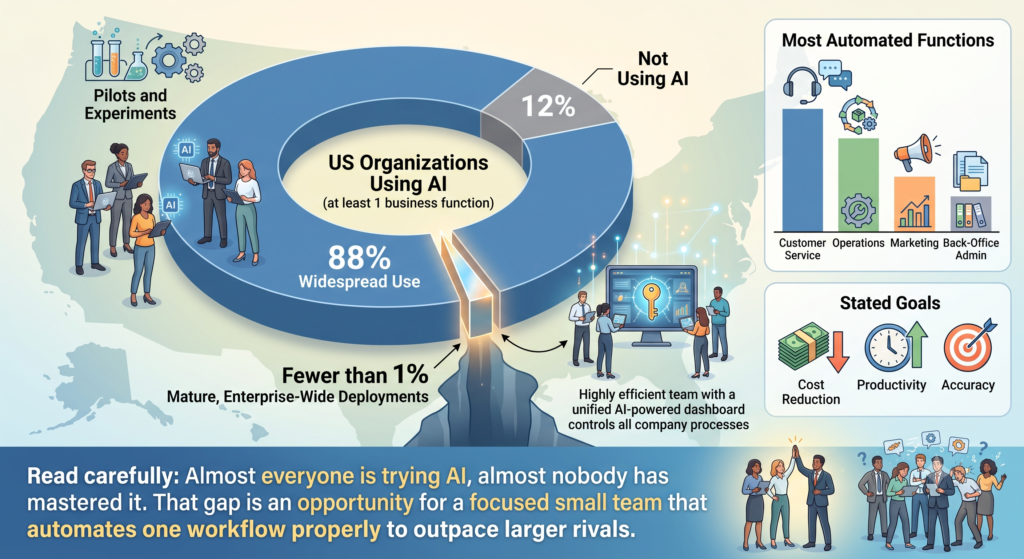
- About 88 percent of US organizations use AI in at least one business function as of 2026.
- Fewer than 1 percent have mature, enterprise-wide deployments. The rest are still pilots and experiments.
- Customer service and operations are the most automated functions, followed by marketing and back-office admin.
- Cost reduction tops the list of stated goals, with productivity and accuracy close behind.
Read those numbers carefully. Almost everyone is trying AI, almost nobody has mastered it. That gap is an opportunity. A focused small team that automates one workflow properly can outpace larger rivals still wandering through pilots.
The US AI Automation Stack, Decoded
The market splits into three layers. Understand the layers and you will never overpay again.
- Workflow tools: Zapier, Make, n8n. Connect apps through APIs. From free to about $25 a month. Perfect for cloud software.
- RPA platforms: UiPath, Automation Anywhere, Power Automate. Mimic human clicks on legacy systems. From $15 per user monthly to six-figure enterprise deals.
- AI agents: ChatGPT-based builders, Claude, and agent frameworks that make decisions. Pricing varies wildly, from $20 a month to thousands for custom deployments.
The right stack is usually one workflow tool plus one AI agent. RPA only when a system has no API. Start there and upgrade on evidence, not hype.
Realistic Costs for US Teams
Budget honestly or the project dies quietly. Here is what typical US deployments actually cost:
| Scale | Tooling | Monthly Cost | Setup Time |
|---|---|---|---|
| Small pilot | Zapier or n8n free tier | $0 to $50 | Hours |
| Growing team | Make + an AI plan | $50 to $300 | Days |
| Mid-size ops | Power Automate or UiPath | $1,000 to $5,000 | Weeks |
| Enterprise | Full RPA suite | $10,000 to $50,000+ | Months |
If your budget is tight, stay in the top two rows. Most automation wins live there. If a vendor pushes you to the bottom row on day one, that is a red flag, not a strategy.
What Actually Works: Three US Examples
A Denver ecommerce store automates customer refund handling with Zapier and an AI summarizer, saving about five hours weekly. A Houston medical billing office uses Power Automate to file claim corrections, cutting errors by half. A San Francisco recruiting firm uses an AI agent to screen resumes before a human ever sees them. None of these built custom software. None spent six figures. They combined one workflow tool with one AI tool and measured the hours saved.
Compliance Checklist for US Teams
Automation is not just about speed. In the USA you must stay legal. Run this checklist before you launch anything:
- Data rules. US customer data falls under state laws like the CCPA and sector rules like HIPAA for health. Know which applies to you.
- Vendor assessment. Confirm your AI tool states where data is stored and whether it trains on your inputs.
- Human review. Keep a person in the loop for anything that touches money, health, or hiring.
- Audit trail. Log what the automation did, so you can show your work in a dispute.
- Revocable access. Keep the ability to switch a tool off instantly without breaking core operations.
This list takes an afternoon and can save you a nightmare. Skip it at your own risk.
How to Start Tomorrow Morning
- Pick one task. Something repetitive that takes your team five-plus hours a week. Reporting, data entry, follow-ups.
- Prototype free. Build the workflow in Zapier or n8n before paying for anything.
- Measure for 30 days. Compare hours saved against hours spent building and running it.
- Scale the winner. Automate the next task only after the first proves real savings.
For hands-on reviews of tested tools, read our Best AI Productivity Tools in 2026 or browse plain-language analysis on the ToolsYards Blog.
One warning before you start: resist the urge to automate everything at once. A single working workflow builds confidence and data. Ten broken ones build resentment. Start Monday with one task, measure honestly, and let the results recruit the rest of your team.
Five Pitfalls That Waste US Budgets
Every failed project I have reviewed repeats the same mistakes. Watch for these:
- Buying before mapping. A license without a process is an ornament. Map first.
- Automating messy data. Bots happily copy your errors faster. Clean the data first.
- Skipping maintenance. Workflow tools break when apps update. Budget time for fixes or the bot dies quietly.
- No owner. Automation without a named keeper gets abandoned in six weeks. Assign one person.
- Ignoring security. AI tools that train on your data leak competitive secrets. Vet every vendor.
Metrics That Prove ROI
Do not report how many bots you built. Report outcomes. The five numbers that matter:
- Hours saved per week per process, compared against a real baseline.
- Error reduction before and after automation, especially in data entry.
- Cycle time from request to completion, for customer and internal teams.
- Cost per transaction once volume is routed through the workflow.
- Time to value from pilot start to measurable savings.
Capture these before you automate. You cannot prove savings you never measured. Teams that skip this step lose budget arguments every single quarter.
Droven.io AI Automation in USA: FAQs
Is Droven.io a tool or a service?
Neither. Droven.io is a free education platform that explains AI automation tools and pricing so you can choose wisely.
What is the cheapest way to start AI automation?
Use a free Zapier or n8n plan to automate one task before paying for anything. Most teams find savings without upgrading at all.
How long does an AI automation pilot take?
Small workflow pilots take an afternoon with free tiers. RPA proofs of concept run two to six weeks. Enterprise programs take months.
How much do US companies spend on AI automation?
Small teams stay under $300 a month with workflow tools. Enterprises can exceed $10,000 a month on full RPA suites and custom AI agents.
Is AI automation legal for US small businesses?
Yes, when you follow state data laws like CCPA, keep human review on sensitive tasks, and maintain audit trails.
Can automation replace US jobs?
It replaces repetitive tasks, not judgment work. Most US teams redeploy saved hours to higher-value work instead of cutting staff.
Which functions benefit most?
Customer service, operations, marketing reporting, and back-office admin deliver the fastest returns in most US deployments.
The Bottom Line
Droven.io AI automation in the USA is a planning problem more than a technology problem. The tools are cheap now and getting cheaper. What separates winners from spectators is process mapping, honest budgets, and small measured pilots. Start with one workflow, keep a human in the loop, and scale what proves itself. Learn how we check AI platforms in Does FrostyTools Use AI?, then automate the boring half of your week.