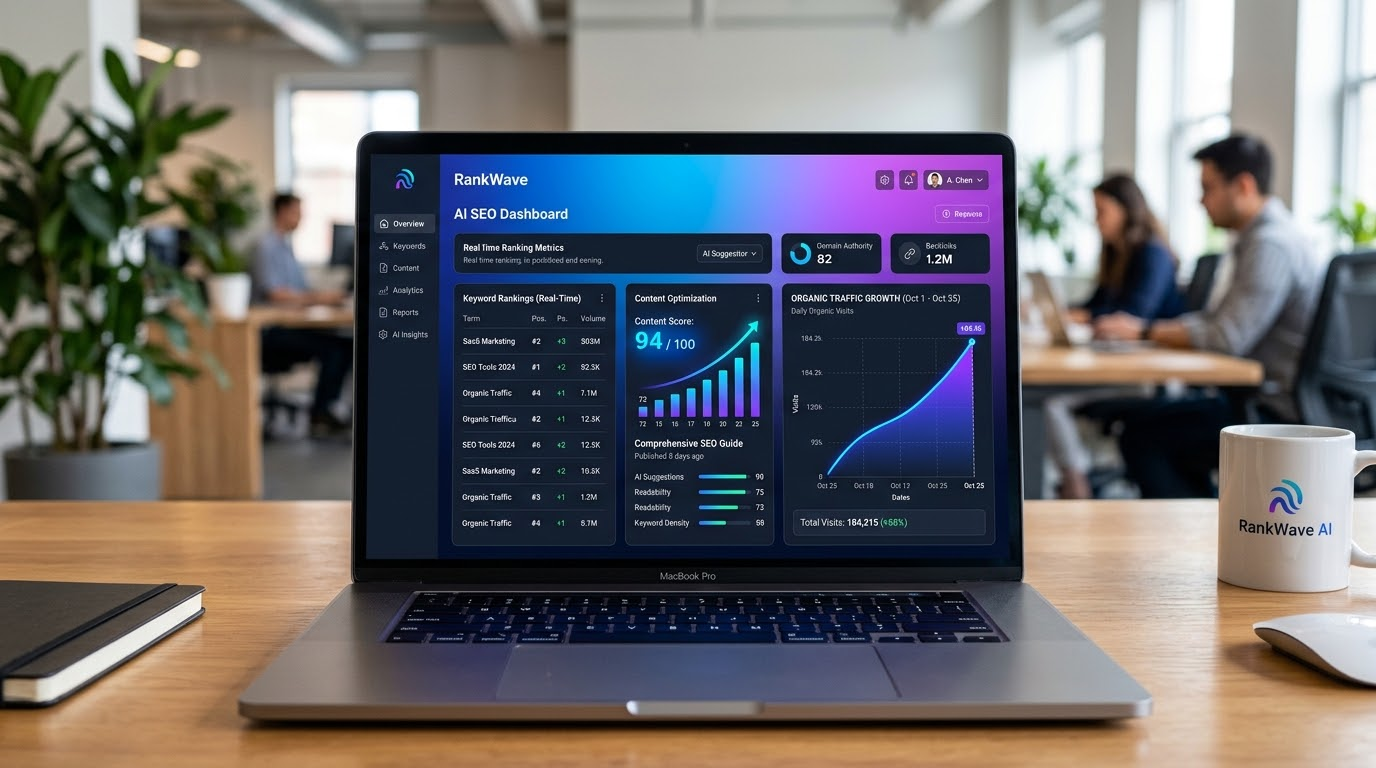
The best AI tools for ranking blogs on Google in 2026 are Surfer SEO, Semrush, Clearscope, Frase, Rankscale.ai, and Junia.ai. Each one tackles a different part of the ranking puzzle, from on-page optimization to AI search visibility tracking. Picking the right tool depends on whether your bottleneck is writing, optimizing, or getting cited by AI assistants like ChatGPT and Google AI Overviews.
When Priya, a content lead at a 12-person B2B startup, watched her blog traffic fall 38% between January and March 2026, she assumed Google had changed something under the hood. It had.
But the real issue was simpler than she expected. Her competitors had started using AI content optimization tools to match search intent at a level her manual keyword research couldn’t reach. She signed up for Surfer SEO on a Tuesday, rebuilt her top five posts using its live Content Score editor, and saw those five articles climb from page three to the top ten within six weeks. The total cost: $99 a month and about four hours of hands-on editing per article.
Key Takeaways
– Surfer SEO delivers real-time, SERP-based writing guidance that tells you exactly which terms, headings, and word counts your blog needs to compete.
– Semrush now includes an AI Visibility Toolkit that tracks your brand mentions inside ChatGPT, Perplexity, and Google AI Overviews alongside traditional rankings.
– Clearscope produces the cleanest content briefs in the industry, built on NLP models from IBM Watson, Google, and OpenAI.
– Frase is the fastest way to go from a keyword to a structured, intent-matched content outline.
– Rankscale.ai is the only standalone tool exclusively focused on Generative Engine Optimization (GEO) tracking across multiple LLMs.
Does this sound familiar? You spend hours writing a blog post, hit publish, and check Google two weeks later. You find your article sitting on page four behind a wall of competitors who wrote half as much.
The old rules don’t hold up anymore. Picking a keyword, putting it in your title, and writing 2,000 words is not enough. Search engines and AI assistants now dissect your content at the entity and topic-cluster level before deciding whether to rank or cite it. This guide breaks down the six AI tools that solve that problem, organized by what they do best, so you can pick the one that matches your actual workflow.
Why Ranking Blogs on Google Requires AI Tools in 2026
Google’s algorithm has always been a moving target. But 2026 introduced two changes that made old-school blog SEO strategies almost worthless.
First, Google rolled AI Overviews into a much larger share of search results. According to early estimates, around 30% of informational queries now trigger an AI-generated summary at the top of the page, pushing traditional blue links further down. Your blog can rank number one and still get fewer clicks because the AI Overview answered the question first.
Second, AI assistants like ChatGPT, Perplexity, and Claude now drive a measurable share of referral traffic. Some publishers report 5% to 15% of their visits coming from AI-generated citations. That means you aren’t just competing for Google’s approval. You’re competing to be the source these language models pull from.
Manual keyword research can’t keep up with this. You can’t hand-count entity mentions, score topical relevance against the top 30 search results, or track whether ChatGPT is citing your competitor’s article instead of yours. These tasks require AI-powered software.
Want a deeper look at how AI writing tools fit into this picture? Read our breakdown of how AI writing tools save you hours every week.
Best AI Tools for Ranking Blogs on Google with On-Page Optimization
If your biggest problem is making the words on the page match what search engines and AI bots expect, these two tools are where you start. They work inside your writing workflow, not outside it.
1. Surfer SEO: Best for Live Writing Guidance
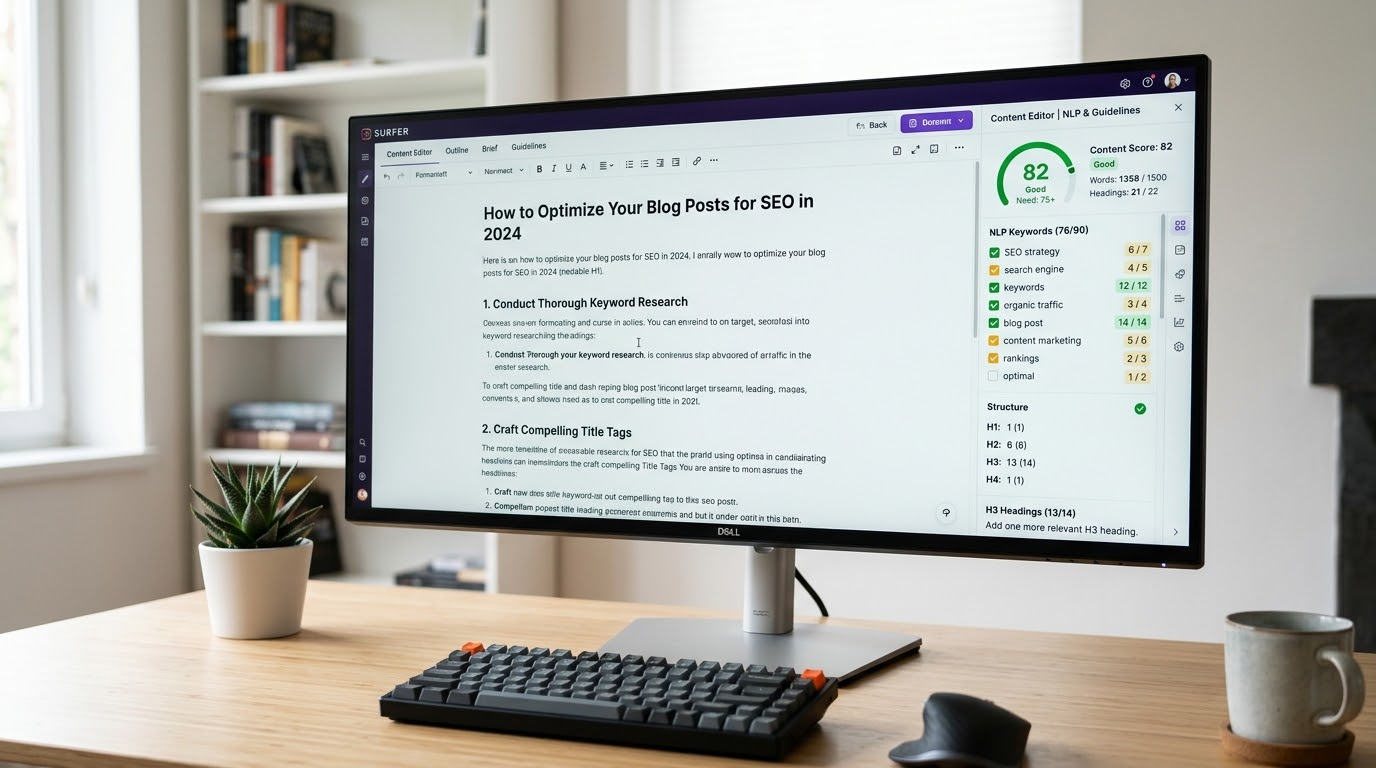
Surfer SEO remains one of the most effective AI tools for ranking blogs on Google through on-page content optimization in 2026. It works by analyzing the pages that currently rank in the top 10 to 20 for your keyword, then translating that analysis into specific actions you can take while you write.
The core feature is the Content Editor. You enter a keyword; Surfer builds a data-backed checklist covering word count targets, heading structure, NLP terms to include, and images needed. As you type, a live Content Score updates in real time. Hit 80 or above and your article is competitive. Fall below 60 and Surfer highlights exactly which gaps are dragging you down.
New in 2026, Surfer added an AI Visibility Tracker. It monitors how often your content is cited in Google AI Overviews, ChatGPT, and Perplexity. This means you can optimize for both traditional SERPs and the new AI answer layer without switching platforms.
| Feature | What It Does |
|---|---|
| Content Editor | Live Content Score based on SERP analysis |
| NLP Term Suggestions | Shows which semantic keywords are missing |
| Outline Builder | Generates heading structures from top performers |
| AI Visibility Tracker | Monitors citations in AI Overviews and LLMs |
- Best for: Content teams and freelance writers who need precise, data-driven feedback while they draft.
- Pricing: Starts at $99/month. Higher tiers include AI Tracker and more queries.
2. Clearscope: Best for Editorial Relevance
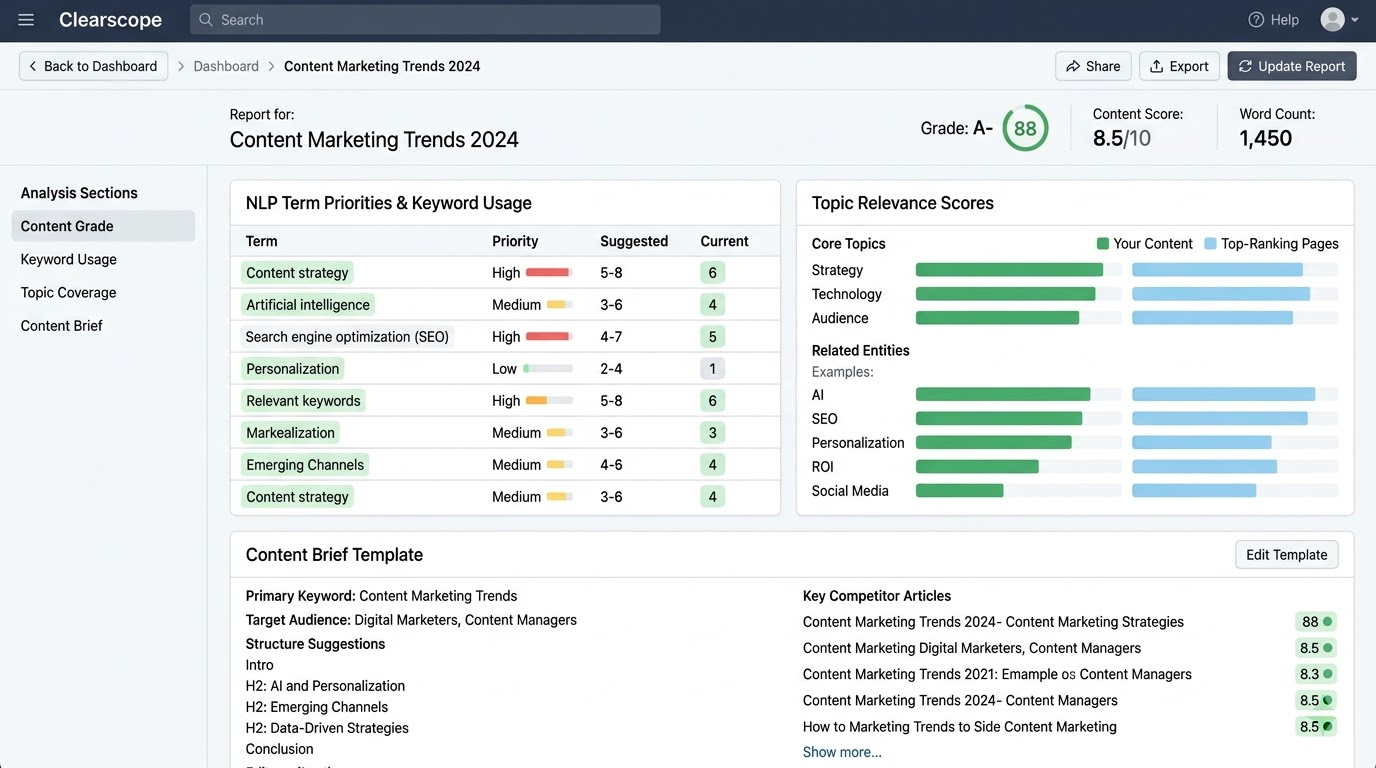
Clearscope takes a different approach. Where Surfer gamifies the writing process with a live score, Clearscope produces deeply detailed content reports that focus on topical relevance above everything else.
It uses advanced NLP models from IBM Watson, Google, and OpenAI to analyze the top 30 to 40 search results for your keyword. The output is a prioritized list of terms and topics your article should cover, ranked by how strongly they correlate with high-ranking pages. There’s no pressure to stuff terms for a score bump because Clearscope’s recommendations genuinely reflect what the best content in your niche is covering.
When David, an editor managing four freelance writers for a health-tech blog, switched from a generic keyword tool to Clearscope, his team’s average time from brief to final draft dropped from seven days to four.
The shareable brief templates meant every writer started from the same playbook: same target terms, same topic map, same quality bar. Their content pass rate with clients jumped from 60% to 90%.
- Best for: Editorial teams and B2B brands where content quality and topical authority matter more than publishing speed.
- Pricing: Starts at $129/month.
All-in-One AI Tools for Ranking Blogs on Google
Sometimes you don’t just need a writing assistant. You need a platform that handles keyword tracking, site audits, competitive analysis, and AI search monitoring in one place.
3. Semrush: Best All-in-One SEO Platform
Semrush has been a staple of the SEO industry for over a decade. But its 2026 updates make it relevant to a new challenge: tracking your brand’s visibility inside AI-generated answers.
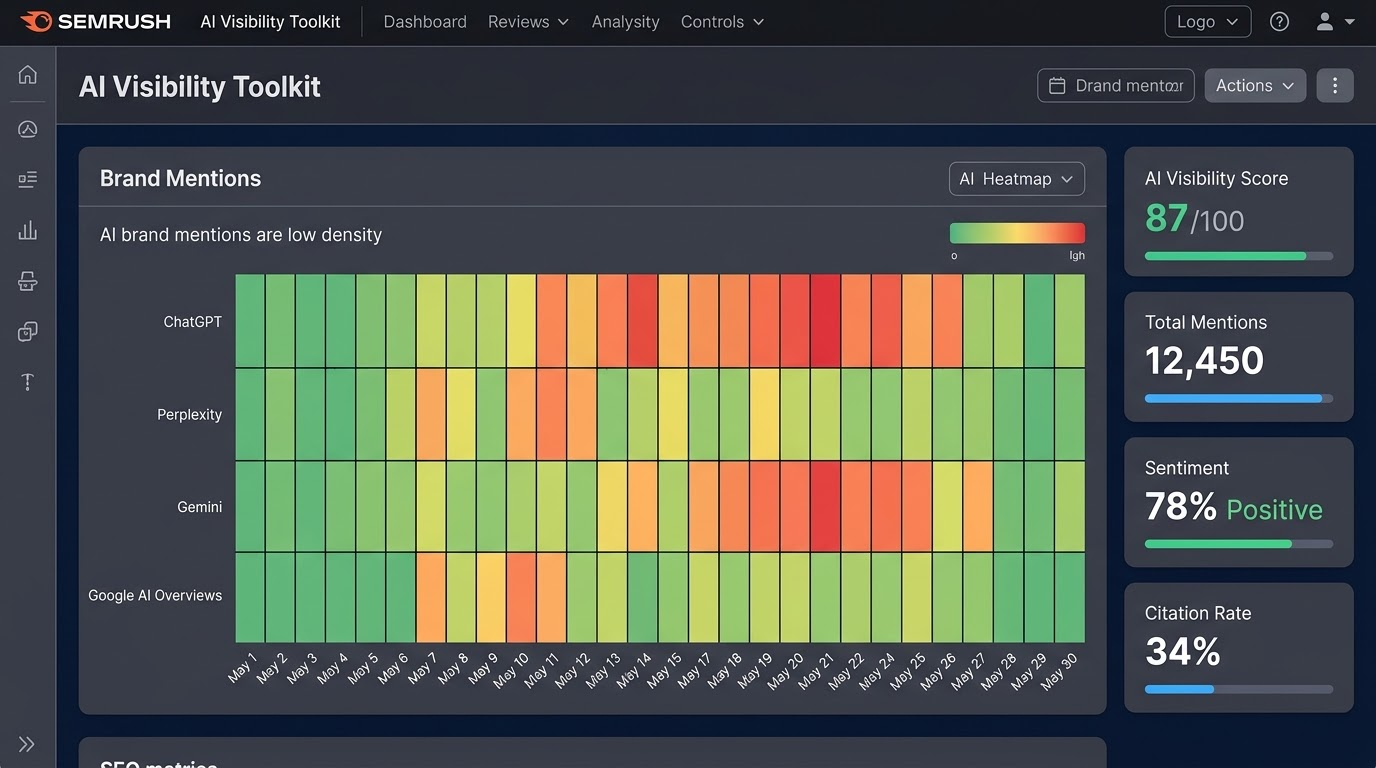
The new AI Visibility Toolkit lets you monitor how often your brand appears in ChatGPT, Gemini, Perplexity, and Google AI Overviews. You can trace those AI mentions back to the SEO signals that caused them, meaning you can see which backlinks, content structures, and entity references are actually driving your AI presence. That’s a level of insight no other all-in-one platform offers right now (Semrush tracks over 239 million prompts across eight regions).
Beyond AI visibility, the full Semrush One suite covers keyword research, backlink intelligence, competitive analysis, content optimization, and technical site audits. If you’re running a team or agency and want everything centralized, this is the platform.
- Best for: Marketing agencies, in-house SEO teams, and anyone who needs traditional SEO and AI visibility tracking under one roof.
- Pricing: Pro starts at $139.95/month. AI Visibility Toolkit available as an add-on ($99/month standalone) or bundled with Semrush One.
Looking for broader productivity gains beyond SEO? See our tested rankings of the best AI productivity tools of 2026.
4. Junia.ai: Best for Automated Blogging at Scale
Junia.ai suits content operations that need to scale without adding a dedicated writing team. Some businesses want to go from zero to 30 published blog posts per month without hiring another writer.
Junia.ai is automated blog SEO software that handles this end to end. You give it a keyword or your website URL. It does its own SERP research and picks a competitive content structure.
Then it drafts a full-length article, adds internal and external links, generates meta tags and schema markup, and publishes directly to WordPress or Shopify. The whole cycle from keyword to live post takes minutes, not days.
Marcus, a solo founder running three niche affiliate sites, was spending 25+ hours a week on blog drafting before switching to Junia.ai. After integration, he reduced his content creation time to roughly three hours per week of editorial review, and his overall organic traffic grew 140% over a single quarter.
The tool doesn’t replace editorial judgment (you still need to fact-check everything it produces), but it eliminates the grunt work that bogs down small teams.

- Best for: Niche site builders, affiliate marketers, and small businesses who need to scale blog output without scaling headcount.
- Pricing: Starting at $17/month.
AI Tools for Ranking Blogs on Google and in AI Search
Traditional SEO gets you ranking on Google. AI search optimization expands that work to ChatGPT, Claude, and Perplexity. But how do you earn citations there? These platforms are now a real source of qualified traffic, and they reward different content signals than Google does.
5. Rankscale.ai: Best for GEO Tracking Across LLMs
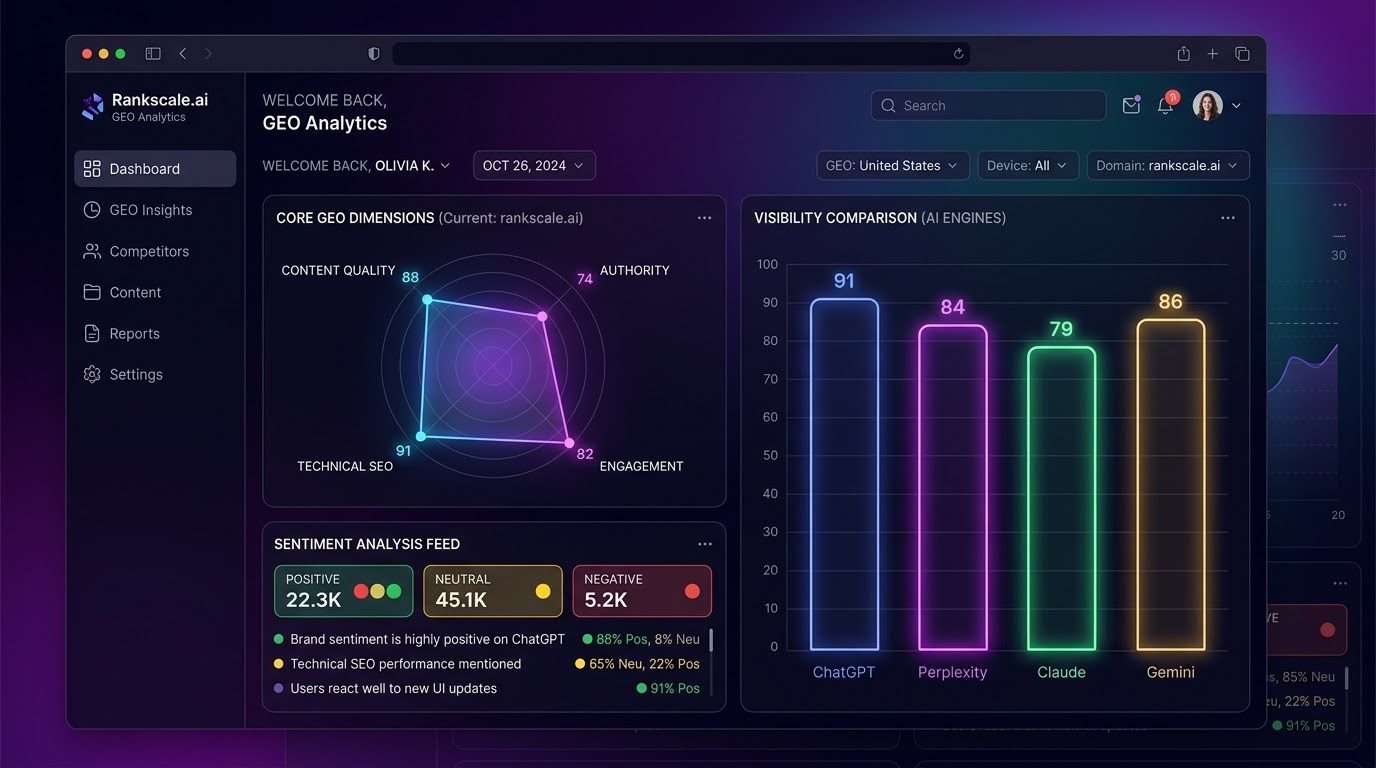
Rankscale.ai is purpose-built for one job: tracking and improving your visibility inside AI-generated answers. It monitors your content’s performance across ChatGPT, Perplexity, Claude, Gemini, and Google AI Overviews with granular detail.
For each keyword you track, Rankscale gives you a Visibility Score, a sentiment analysis of how AI describes your brand, and a list of the exact sources the AI model cited instead of you. The “AI search readiness score” evaluates your content on four dimensions: content quality, authority and trustworthiness, technical SEO and page structure, and user engagement signals. From there, it generates a prioritized to-do list of improvements.
| Metric | What It Tells You |
|---|---|
| Visibility Score | How often your content appears in LLM answers |
| Sentiment Analysis | Whether AI describes your brand positively |
| Source Citations | Which competing pages the AI cites instead |
| Readiness Score | Overall optimization level for AI search |
- Best for: SEO strategists and data-driven marketing teams who treat GEO as a distinct growth channel.
- Pricing: Credit-based, starting around $20/month.
6. Frase: Best for Fast SERP Research and Content Briefs
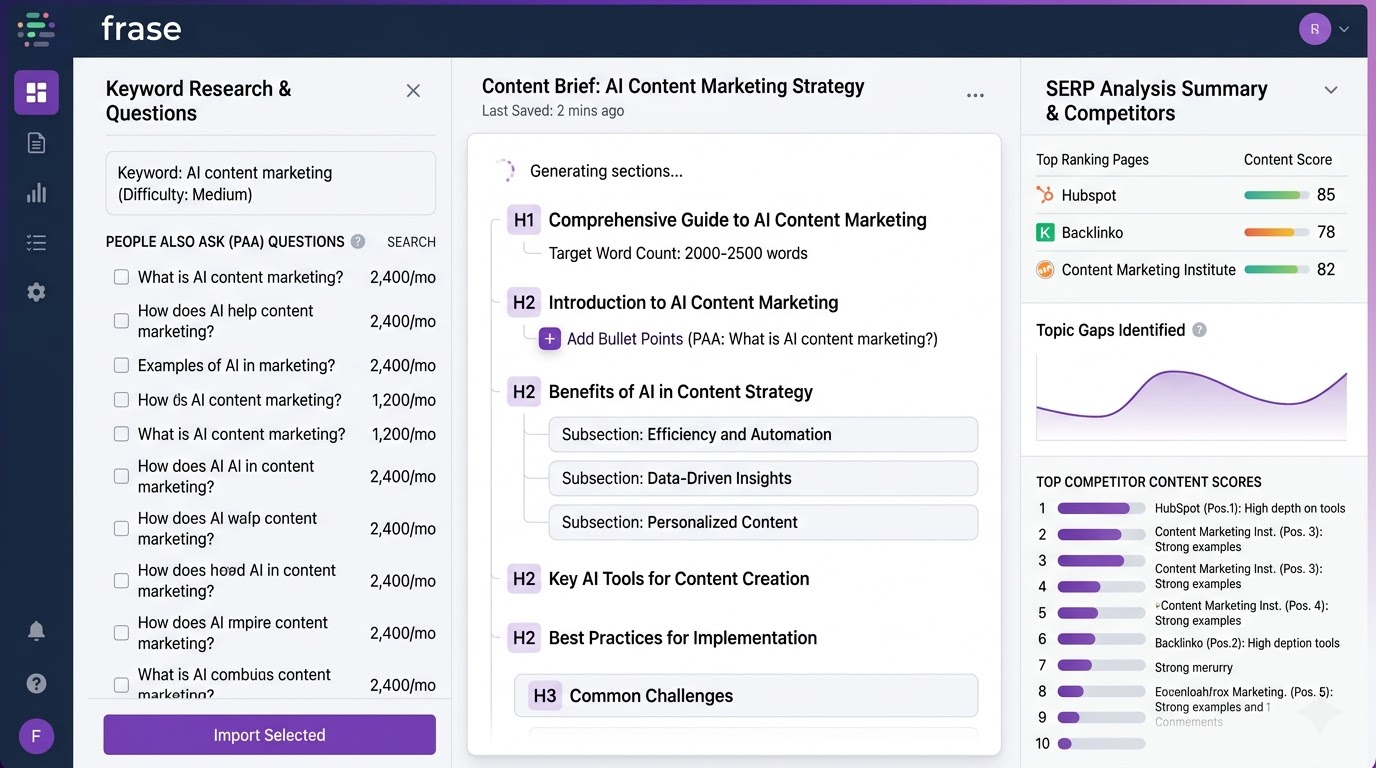
Frase sits at the beginning of the content creation pipeline. Its specialty is speed: you enter a keyword, and within minutes it summarizes the current SERP, pulls common “People Also Ask” questions, extracts relevant Reddit and forum discussions, and assembles a structured content brief.
This is the tool you reach for when the bottleneck is not the writing itself but getting from a keyword to an outline that actually reflects what real people are searching for. Once the brief is built, Frase provides paragraph-level optimization checklists to make sure you cover every critical subtopic.
- Best for: Content managers and solo marketers who need to move from keyword to outline quickly.
- Pricing: Starting at $49/month.
How to Pick the Right Tool for Your Workflow
When comparing AI tools for ranking blogs on Google, the worst mistake is buying five platforms and using none of them well. Start with your biggest bottleneck:
- Writing quality is the problem: Pick Surfer SEO or Clearscope. Surfer gives you live, gamified feedback. Clearscope gives you cleaner briefs and deeper relevance mapping.
- You need everything in one dashboard: Pick Semrush. It handles keyword research, site audits, competitive analysis, and now AI visibility tracking.
- You need to scale content output fast: Pick Junia.ai. It automates research, drafting, and publishing for blogs you can fine-tune later.
- You’re focused on AI search specifically: Pick Rankscale.ai. It’s the most granular GEO tracker available.
- Your briefs are the bottleneck: Pick Frase. It’s the fastest way to get from a keyword to a structured outline.
Curious about how other AI tools handle common tasks behind the scenes? Here’s our analysis of how FrostyTools uses AI.
Frequently Asked Questions
Are AI SEO tools worth the cost for small blogs?
Yes. Even a $49/month tool like Frase or a $17/month tool like Junia.ai can save 10 to 20 hours of manual research and writing per month. If your time is worth more than $5/hour, the economics make sense from day one. Start with a free trial before committing to any paid plan.
Can AI SEO tools guarantee a first-page ranking?
No tool can guarantee rankings because Google’s algorithm considers hundreds of factors, including backlinks, domain authority, and user behavior. What these tools guarantee is that your on-page optimization is competitive. They close the content gap so ranking depends on factors you can control.
Do I need to optimize for AI search (GEO) or just Google?
Both. Early data suggests 5% to 15% of website traffic now comes from AI sources, and that share is growing. If you optimize only for traditional Google, you’re leaving a growing traffic channel on the table. Tools like Semrush and Rankscale let you track both from the same workflow.
Will Google penalize AI-optimized content?
Google doesn’t penalize content for being AI-assisted. It penalizes content that is low quality, unhelpful, or spammy. Using AI tools to improve relevance, structure, and topical coverage actually aligns with what Google rewards. The key is human editorial oversight on every final draft.
Which tool should I start with if I can only afford one?
If you already write well and need optimization guidance, start with Surfer SEO ($99/month). If you need to scale output first and optimize later, start with Junia.ai ($17/month). If your priority is understanding the competitive landscape, Semrush offers the broadest single-platform value.
How do AI SEO tools differ from ChatGPT?
ChatGPT is a general-purpose language model. AI SEO tools are purpose-built for search optimization. They connect to SERP data, NLP models, and ranking databases that ChatGPT doesn’t have access to. Think of ChatGPT as a writing assistant and AI SEO tools as your search strategy engine.
Conclusion
The best AI tools for ranking blogs on Google in 2026 go far beyond keyword density checkers. Surfer SEO, Semrush, Clearscope, Frase, Rankscale, and Junia.ai each solve a specific piece of the ranking puzzle, from live writing feedback to full-stack AI visibility tracking.
The smartest move is to pick one tool that matches your biggest pain point right now, master it, and expand your stack only when the data justifies it. The blogs that rank today are the ones that match real search intent, cover topics comprehensively, and structure answers for both human readers and AI bots.
Compare these AI tools for ranking blogs on Google, choose the best fit, and start with the provider’s free trial or lowest-cost plan today.